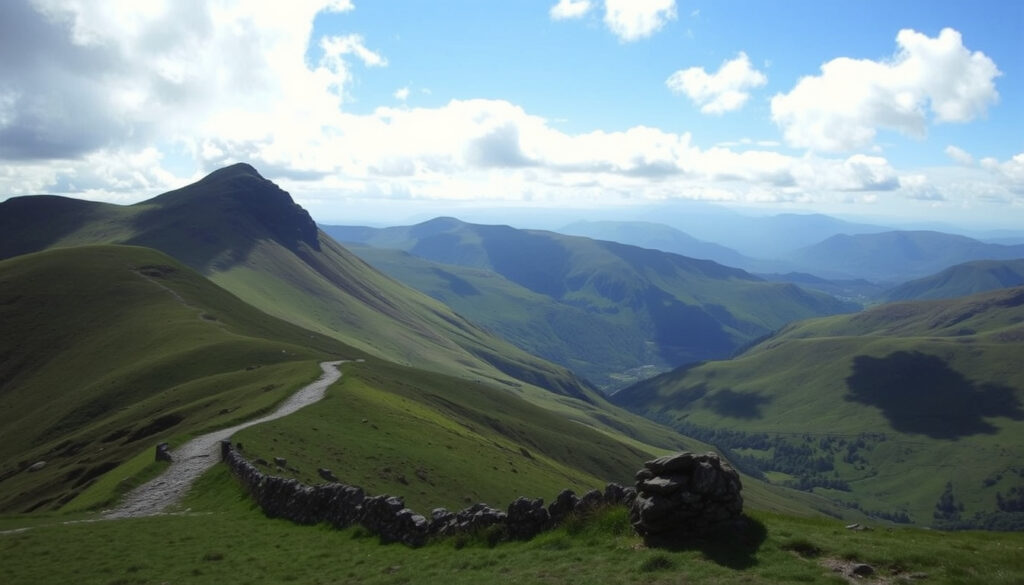
Cat Bells – Complete Guide to the Walk, Parking and History
A short but rewarding climb north of Keswick, Cat Bells is one of the Lake District’s most popular fells. Its modest height and spectacular views of Derwentwater attract walkers of all abilities, but its fame also brings crowds and limited parking. This guide covers the route, logistics, and the story behind its unusual name so you can plan a smooth day out.
The classic walk is often described as moderate. It involves a steep, stepped ascent and a short stretch of easy scrambling near the summit. Most walkers complete the circular route from Hawes End in two to three hours.
How Long is the Cat Bells Walk and How Difficult Is It?
Cat Bells at a Glance
- Height: 451 m (1,480 ft)
- Distance: 3.5 miles (5.7 km) for the classic route
- Time: 2–3 hours (including stops)
- Difficulty: Moderate – a short steep section and minor scrambling
Key Insights
- Cat Bells is one of the most popular fells in the Lake District, attracting thousands of walkers annually.
- The classic route from Hawes End is a linear out-and-back, but a circular walk via Hause Gate is possible.
- Parking is extremely limited at the start; early arrival or use of public transport is strongly recommended.
- The name ‘Cat Bells’ likely derives from Old Norse ‘katt’ (wild cat) and ‘bell’ (a rounded hill), but alternative theories exist.
- Despite its low height, the summit offers panoramic views of Derwentwater, Borrowdale, and the Skiddaw range.
- The walk is generally considered dog friendly, including on the boat crossing from Keswick, though the steep sections and rocky steps require control and fitness.
- Reported distances vary slightly by route choice, with most guides putting it at 3.5 miles, 3.6 miles, 3.8 miles, or around 4 miles.
Cat Bells Quick Facts
| Category | Detail |
|---|---|
| Location | English Lake District, Cumbria |
| Height | 451 m (1,480 ft) |
| Prominence | 87 m (285 ft) |
| Parent Peak | Maiden Moor |
| OS Grid Reference | NY 244 196 |
| Classic Route Distance | 3.5 miles (5.7 km) one way |
| Typical Walking Time | 2–3 hours round trip |
| Difficulty | Moderate (steep ascent, minor scramble) |
| Start Point | Hawes End (limited parking) |
| Dog Friendly | Yes, but keep on lead near livestock and steep edges |
Where to Park for Cat Bells and How to Get There?
Parking is the biggest practical challenge for anyone planning the Cat Bells walk. Spaces at or near Hawes End, Gutherscale, and the roadside lay-bys are very limited and fill quickly in peak periods. The Lake District National Park Authority recommends early arrival or using public transport.
Many walkers choose to start their day from Keswick instead. The town has larger car parks, and the Derwentwater launch service offers a direct boat to Hawes End Landing Stage. This approach avoids the parking bottleneck and adds a relaxing start to the outing. Keswick Tourism describes the route as a circular walk of about 3.5 miles that takes roughly three hours.
Starting in Keswick and taking the launch across Derwentwater to Hawes End is a practical way to avoid the parking shortage at the trailhead. The approach also makes the walk feel more relaxed and scenic, as several guides note.
If you are driving directly to Hawes End, expect to park in a small lay-by or field and be prepared for a busy scene at weekends and in holiday season.
Route and Terrain Details
The standard walk starts at Hawes End and climbs steeply at first via stepped paths. Near the top, the path involves some minor scrambling over rocky sections. The descent follows a lower bridleway or terrace path back toward Brandelhow and the lakeshore, creating a classic loop.
One route guide confirms the walk is dog friendly, including on the boat crossing from Keswick. The steep sections and rocky steps mean that control and the dog’s fitness are still important, and leads should be used near livestock and edges.
What is the History and Origin of the Name Cat Bells?
The exact origin of the name Cat Bells is not settled, but the most common explanation is that it comes from Old English or Old Norse. One theory, mentioned by several sources, is that “Catbells” may be a distortion of “Cat Bields,” meaning the home of the wild cat. The word “bell” in this context likely refers to a rounded hill, a meaning found in several Northern English place names.
Another possibility is that “bell” refers to a beacon hill, though this is less widely supported. The name has been recorded since medieval times, and the fell was already well known to early tourists and writers centuries later.
History of Cat Bells
- Prehistoric: The area was used for grazing and possibly as a route across the fells.
- Medieval: The name ‘Cat Bells’ was first recorded, likely derived from Old Norse ‘katt’ and ‘bell’.
- 18th–19th century: The fell became popular with early tourists and writers, including Alfred Wainwright who featured it in his guides.
- 20th century: It was designated as part of the Lake District National Park in 1951. Visitor numbers continued to increase.
- 2020s: Parking restrictions were introduced due to overcrowding, and social media popularity drove further growth in visitor numbers.
What We Know and What’s Uncertain
| Established Information | Information That Remains Unclear |
|---|---|
| Cat Bells is a fell in the Lake District with a height of 451 m. | The exact origin of the name ‘Cat Bells’ is debated. The most common theory is ‘wild cat hill’ from Old Norse, but others suggest ‘bell’ refers to a beacon or a bell-shaped hill. |
| The classic walk is approximately 3.5 miles and takes 2–3 hours. | Whether the name references actual wild cats (which were once present) or simply a metaphorical ‘cat’ is unclear. |
| Parking is very limited at Hawes End. | |
| The route involves a steep section and minor scrambling. |
Why Cat Bells is So Popular
Cat Bells’ accessibility from Keswick, its relatively low height, and spectacular summit views make it a perfect introduction to fell walking. Its prominence in Alfred Wainwright’s Pictorial Guide to the Lakeland Fells cemented its fame. However, its popularity has also led to erosion and parking issues, prompting the National Park to encourage off-peak visits and use of the shuttle bus from Keswick.
The fell is part of the Derwentwater area, which is managed by the National Trust. Its location on the western shore of the lake gives it a dramatic setting, with views stretching across the water to the Skiddaw range and the Borrowdale valley.
Sources and Key Statements
“Cat Bells is a fell in the English Lake District in the county of Cumbria. It has a height of 451 metres (1,480 ft) and is one of the most popular fells in the Lake District.”
— Wikipedia
“Cat Bells is one of the Lake District’s most popular fells, meaning it does get busy and parking is extremely limited at the start of the walk.”
— Lake District National Park Authority
“Distance – Approx 3.5 miles / 5.7 kms Time – 3 hours approx plus stops Difficulty – Moderate. A short steep section on ascent with some minor scrambling.”
— Keswick – Official Tourism Site
After Your Cat Bells Walk
Once you have completed the Cat Bells walk, consider extending your day with a route to Maiden Moor or a stroll along the Derwentwater shore. For a more challenging day, join the ridge to Dale Head or explore the valleys of Borrowdale and Newlands. The Keswick area offers many other low-level walks and attractions.
If you are planning your trip, you might also find the Dr Martens Sandals 2025 UK Guide useful for footwear considerations on a day out. For longer walks, the Red Bull – Ingredients, Alcohol, Ownership, and Pricing article covers an energy drink option that hikers sometimes use, though water is always the primary recommendation.
Frequently Asked Questions
Is Cat Bells a mountain?
Cat Bells is classified as a ‘fell’ (a term used in Northern England for a hill or mountain). It is 451 m high, which is below the 600 m threshold for mountain status in the UK, but it is often referred to as a mountain in a walking context.
Can you walk Cat Bells with a baby?
The steep sections and narrow paths make it challenging for baby carriers. It is not recommended for very young children, but older children (with experience) may manage the route.
Is there a shorter route up Cat Bells?
The classic route from Hawes End is the most direct. There is no significantly shorter route, but you can turn back early if needed.
What is the best time of day to walk Cat Bells?
Early morning or late afternoon to avoid crowds. Weekdays are quieter than weekends. The walk is best in good weather as the summit is exposed.
Are there toilets at Cat Bells?
No public toilets at the start. Nearest facilities are in Keswick or at the Cat Bells car park, which is not equipped. Plan accordingly.
More related posts
 Is Vaping Better Than Smoking – Expert Guide and Latest Research
 B&Q Huddersfield – Hours, Services, Parking & Products
 Ian Watkins – The Prison Death of a Notorious Child Sex Offender
 Tess Daly – Age, Net Worth, and Split Rumors (2025 Update)
 Christopher Lloyd – His Age, Net Worth, Family, and Career in 2025
 Benjamin Zephaniah – Cause of Death, Books, and Peaky Blinders Legacy
 Freddie Mercury – Biography, Death, and Legacy of Queen’s Frontman
 Mark Benton – Age, Wife, Weight Loss and TV Shows 2025