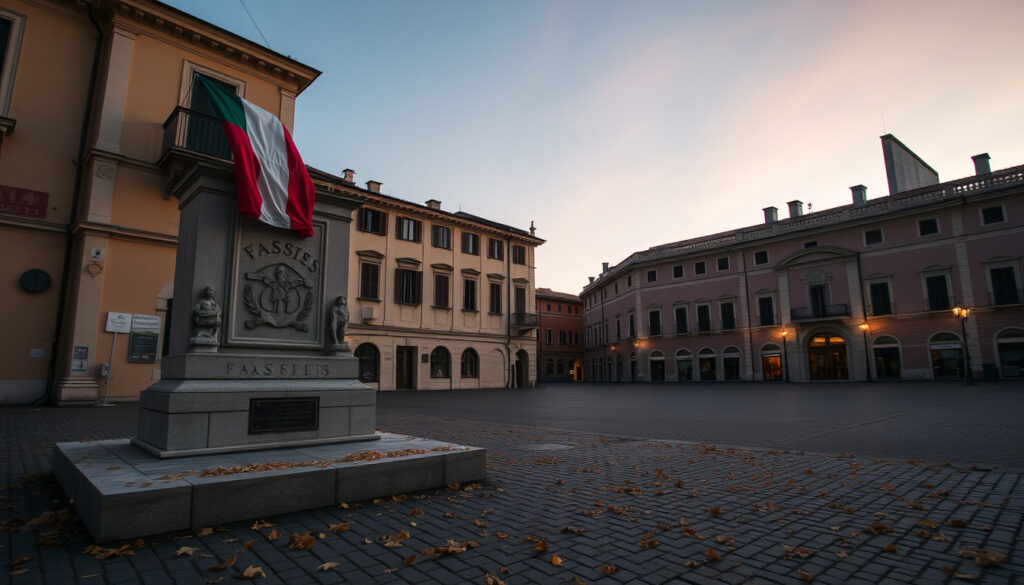
Benito Mussolini – Biography, Death, Children and Legacy
Benito Mussolini, the founder of Italian fascism, rose from socialist journalist to become Europe’s first fascist dictator. Known as Il Duce, he ruled Italy with an iron fist from 1922 until his overthrow in 1943, forged a deadly alliance with Adolf Hitler, and led his nation into a war that ended in ruin and his own violent death. His life story is a stark lesson in how economic turmoil and political fear can pave the way for tyranny.
Born into modest circumstances, Mussolini began his political life on the left before executing a dramatic ideological reversal. By blending nationalism, militarism, and authoritarianism, he created a new political creed that inspired copycat regimes across Europe. His legacy remains deeply controversial, marked by colonial violence, war, and the collapse of democracy.
This article examines the key facts about Mussolini — his origins, his family, the circumstances of his death, and the historical judgment on his rule. It draws on established sources and clarifies what is known with certainty versus what remains debated among historians.
Where and When Was Benito Mussolini Born?
Benito Amilcare Andrea Mussolini
29 July 1883, Predappio, Italy
28 April 1945, near Dongo, Italy
Founder of Italian Fascism, Prime Minister (1922–1943), Il Duce
Benito Mussolini entered the world on July 29, 1883, in the small town of Predappio, located in the Emilia-Romagna region of northern Italy. His full birth name was Benito Amilcare Andrea Mussolini, a choice that reflected his father’s political sympathies: he was named after Benito Juárez, the leftist Mexican revolutionary. His father, Alessandro Mussolini, was a blacksmith and an ardent socialist who passed on his political passions to his son.
Key Insights into Mussolini’s Rise and Fall
- Mussolini’s regime was the first to use the term “fascism” and inspired later dictators.
- He allied Italy with Nazi Germany and Imperial Japan in World War II, leading to his downfall.
- Mussolini was initially a socialist journalist before founding the Fascist Party.
- His death by execution was followed by public display and mutilation of his corpse.
- His children had varied fates: some became political figures, others artists or rejected his legacy.
| Category | Detail |
|---|---|
| Spouse | Rachele Mussolini (m. 1915) |
| Children | Edda, Vittorio, Bruno, Romano, Anna Maria; plus stepson Benito Albino |
| Political party | National Fascist Party (PNF) |
| Title | Il Duce (“The Leader”) |
| Height | 1.70 m (5’7″) |
| Last words | “Shoot me in the chest” (reportedly) |
Benito Mussolini Country
Mussolini was born, ruled, and died in Italy. His entire political career was centered on transforming the Kingdom of Italy into a fascist empire. After World War I, he exploited widespread disillusionment with the liberal state, fear of communism, and economic hardship to build a mass movement. His vision was a restored Roman empire that would dominate the Mediterranean, which he called Mare Nostrum.
Benito Mussolini Teacher
Before entering politics, Mussolini worked as a schoolteacher for a short period in his early 20s. He taught at elementary schools in the province of Emilia-Romagna. The experience did not last long; his restless temperament and growing political ambitions soon drew him toward journalism and activism. He eventually became the editor of Avanti!, the official newspaper of the Italian Socialist Party, where he honed the rhetorical skills that would later define his political style.
Benito Mussolini Definition
Benito Mussolini is defined historically as the founder of Italian fascism and the dictator who ruled Italy from 1922 to 1943 under the title Il Duce. He created the first fascist regime in Europe, characterized by extreme nationalism, suppression of political opposition, state control of the economy through corporate bodies, and an aggressive foreign policy. His alliance with Adolf Hitler proved disastrous for Italy.
Who Were Benito Mussolini’s Children?
Mussolini had five children with his wife Rachele Guidi, whom he married in 1915. He also fathered a son, Benito Albino, with an earlier partner. The lives of his children reflect the complexities of being born into a dictator’s family, with some embracing his legacy and others distancing themselves from it.
His legitimate children were: Edda (who married Count Galeazzo Ciano, Mussolini’s foreign minister), Vittorio, Bruno, Romano, and Anna Maria. Romano Mussolini gained some fame as a jazz musician, while Edda became a notable political figure in her own right. Benito Albino Mussolini, the son from an earlier relationship, was raised in relative obscurity.
For more biographical profiles of controversial leaders who shaped the 20th century, see Richard Nixon – Biography, Watergate Scandal and Lasting Legacy and Osama Bin Laden – Biography, Death and Enduring Legacy. Both articles explore the arc from power to downfall.
Romano Mussolini
Romano Mussolini (1927–2006) was Mussolini’s fourth child with Rachele. After the war, he became an accomplished jazz pianist, performing and recording under a stage name for a time. He formed his own group, the Romano Mussolini Ensemble, and collaborated with international jazz artists. Despite his father’s legacy, he pursued a purely artistic life, though his surname always carried political weight in Italy.
Benito Albino Mussolini
Benito Albino Mussolini (1915–1942) was Mussolini’s firstborn son, born to Ida Dalser, a woman Mussolini had a relationship with before marrying Rachele. The existence of this son was largely suppressed by the fascist regime. Albino was institutionalized in a psychiatric hospital after repeatedly claiming his parentage, and he died there at the age of 27 under unclear circumstances.
Rachel Mussolini Politician
Rachele Mussolini (1890–1979) was not a politician herself, but she was a visible public figure as Mussolini’s wife. After his death, she wrote memoirs and occasionally gave interviews. Her grandson, Romano Mussolini’s son, also named Romano, entered politics and served as a member of the European Parliament. The Mussolini family name has thus persisted in Italian public life.
How Did Benito Mussolini Die?
Mussolini was executed on April 28, 1945, near the town of Dongo on Lake Como, as World War II drew to a close. His death was swift and brutal, and the aftermath was deliberately public, meant to signal the definitive end of fascist rule in Italy.
After being ousted in 1943 and rescued by German commandos, he established the Italian Social Republic, a puppet state in northern Italy. As Allied forces advanced and German defeat became certain, Mussolini attempted to flee to neutral Switzerland. He was captured by communist partisans before reaching the border. He was summarily executed by machine gun fire near the village of Giulino de Mezzegra. His body was brought to Milan and hung upside down in Piazzale Loreto alongside other executed fascists.
Online searches for “Benito Mussolini death face” often return graphic, manipulated, or misattributed photographs. Many images circulating on social media are fakes or show other victims. The authentic images from the Piazzale Loreto display are well-documented but disturbing, showing his body publicly desecrated. Historians advise relying on verified archives rather than viral imagery.
According to some accounts, his last words were “Shoot me in the chest,” though the exact wording varies among sources. What is not disputed is that the execution was summary and that his body was subsequently mutilated by the crowd.
The circumstances of Mussolini’s death are well-established: capture by communist partisans, execution near Lake Como, and public display in Milan. However, the precise details of the execution order and the identity of the partisan who fired the fatal shots remain subjects of historical debate. Several partisans later claimed credit.
Was Benito Mussolini a Bad Leader?
The question of whether Mussolini was a “bad” leader is answered by a near-consensus among historians. By any standard measure — respect for human rights, economic management, military success, or institutional stability — his rule was profoundly destructive. He dismantled democratic institutions, outlawed opposition parties, established a secret police force, and used propaganda to maintain a cult of personality.
Under his leadership, Italy committed atrocities. He ordered the Pacification of Libya, which many scholars consider a genocide. His regime enforced racial laws in 1938, targeting Italian Jews. His decision to enter World War II on the side of Nazi Germany proved disastrous for Italy, leading to military defeat, occupation, and civil war.
Benito Mussolini Facts
Several key facts summarize his record. He signed the Lateran Treaty with the Vatican in 1929, ending decades of hostility between the Italian state and the Catholic Church, and establishing Vatican City as an independent entity. His regime demanded constant enthusiasm from the population — what historians call a “total state” — rather than mere passive obedience. He was overthrown in 1943 when his own Grand Council of Fascism voted him out of power.
Benito Mussolini Definition
In historical terms, Mussolini is defined as the architect of fascism. His ideology combined ultranationalism, corporate statism, and anti-communism with a cult of leadership. While his alliance with Hitler is well known, he was the less dominant partner, and his influence on Nazi ideology was limited. His legacy remains a symbol of authoritarianism, war, and the fragility of democracy.
What Books and Drawings Are Associated with Benito Mussolini?
Mussolini was a prolific writer and propagandist who understood the power of media. He authored several books and countless articles, and his image was disseminated through photographs, paintings, and cartoons. Both serious historical studies and satirical works have kept his face in public memory.
Benito Mussolini Book
Among the most significant books are his own writings, including The Doctrine of Fascism (1932), which he co-authored with Giovanni Gentile. This text lays out the philosophical foundations of his regime. Later biographies include Denis Mack Smith’s Mussolini: A Biography, widely regarded as a authoritative scholarly work. Other notable titles include Mussolini’s Italy by R. J. B. Bosworth and The Fascist Revolution by George L. Mosse.
Benito Mussolini Drawing
Numerous drawings and cartoons of Mussolini exist, ranging from propaganda portraits to savage satires. The British cartoonist David Low produced famous caricatures that depicted Mussolini as a pompous, posturing figure. Italian propaganda artists, by contrast, created heroic images of Il Duce as a modern Caesar. These visual works are studied today as artifacts of how dictatorships manage their public image.
What Were the Key Events in Mussolini’s Life?
- 1883 — Born in Predappio, Italy.
- 1902–1912 — Worked as a teacher, journalist, and socialist activist.
- 1914 — Expelled from Socialist Party for supporting war; founded Fasci d’Azione Rivoluzionaria.
- 1919 — Formed the Fasci Italiani di Combattimento (later Fascist Party).
- 1922 — March on Rome; became Prime Minister.
- 1925 — Assumed dictatorial powers, outlawed other parties.
- 1936 — Alliance with Nazi Germany (Rome-Berlin Axis).
- 1940 — Italy entered WWII on side of Germany.
- 1943 — Ousted by Grand Council of Fascism; arrested; rescued by Germans; established puppet state.
- 1945 — Captured by partisans, executed near Lake Como.
What Is Known and What Remains Uncertain About Mussolini?
| Established Information | Information That Remains Unclear |
|---|---|
| Mussolini was executed by Italian partisans on 28 April 1945. | Details of his last words vary among accounts. |
| He had five biological children with Rachele Mussolini plus an adopted son. | The exact photograph of his “death face” is debated; some images are fake or misattributed. |
| He was the founder of Italian fascism and dictator until 1943. | The extent of his personal involvement in certain war crimes is still debated by historians. |
| He signed the Lateran Treaty with the Vatican in 1929. | The nature of his relationship with Hitler and influence on Nazi ideology remain subjects of scholarly discussion. |
What Is the Historical Context of Mussolini’s Rise?
Mussolini’s rise occurred in the volatile aftermath of World War I. Italy, though technically on the winning side, was deeply disillusioned by the Treaty of Versailles, which delivered far less territorial gain than was promised. The economy was in crisis, unemployment was high, and strikes and factory occupations created a climate of fear among the middle and upper classes. Into this vacuum stepped Mussolini, promising order, national greatness, and a crackdown on socialists.
His regime combined nationalism, authoritarianism, and corporate statism — the latter being a system in which the state mediated between workers and employers, effectively controlling both. The cult of Il Duce was built on propaganda, control of the press, and the projection of a heroic, infallible leader. This model proved influential, providing a template for future dictators.
Mussolini’s alliance with Hitler was asymmetrical. Italy was the weaker partner from the start, lacking Germany’s industrial base and military capacity. The relationship ultimately dragged Italy into a war it was not prepared for, leading to military defeat, German occupation, and a bloody civil war between fascists and partisans.
What Are the Most Reliable Sources on Mussolini?
“It is humiliating to remain with our hands folded while others write history. We want to create history.”
— Mussolini, 1922, as cited in many biographies.
“Everything in the state, nothing outside the state, nothing against the state.”
— Mussolini’s fascist doctrine, widely referenced.
The most reliable sources for studying Mussolini include established reference works and academic histories. Britannica’s entry on Mussolini offers an expert-written summary of his life and legacy. Wikipedia’s page is comprehensive and regularly updated, with extensive citations. The United States Holocaust Memorial Museum’s Holocaust Encyclopedia provides context on his regime and its relationship to Nazi Germany. For details on his death, the National WWII Museum’s article is a solid resource. A detailed scholarly analysis is available in a PDF by Klinkhammer (2023) via Perspectivia.net.
Key book-length biographies include Denis Mack Smith’s Mussolini: A Biography and R. J. B. Bosworth’s Mussolini’s Italy. For a shorter overview, documentary videos such as those from Biography provide accessible summaries.
What Is Benito Mussolini’s Lasting Legacy?
Benito Mussolini is remembered as the architect of fascism and the leader who plunged Italy into World War II, ending in total destruction and his own execution. His legacy remains a warning about the dangers of authoritarianism, the manipulation of mass media, and the fragility of democratic institutions. For further reading on figures whose careers followed similar arcs from power to downfall, see the biography of Richard Nixon – Biography, Watergate Scandal and Lasting Legacy.
Frequently Asked Questions About Benito Mussolini
Benito Mussolini book
Many books have been written about Mussolini, from biographies like Mussolini: A Biography by Denis Mack Smith to his own writings like The Doctrine of Fascism.
Benito Mussolini drawing
Numerous drawings and cartoons of Mussolini exist, often satirical or propaganda-based. Some are by famous artists like David Low.
Benito Mussolini definition
Benito Mussolini was the founder of Italian fascism and the dictator of Italy from 1922 to 1943, known as Il Duce.
Who was Benito Mussolini’s teacher?
Before politics, Mussolini worked as a schoolteacher for a short period in his early 20s.
What does “Il Duce” mean?
“Il Duce” means “The Leader” in Italian, a title Mussolini used to emphasize his absolute authority.
How tall was Mussolini?
Mussolini was about 1.70 meters (5 feet 7 inches) tall, which was average for Italian men of his time.
Did Mussolini have grandchildren?
Yes. Through his son Romano, he has grandchildren who entered politics, including a grandson also named Romano who served in the European Parliament.
Was Mussolini a socialist?
Yes, in his early career Mussolini was a prominent socialist journalist and editor of Avanti!, before being expelled for supporting World War I.
What was the Pact of Steel?
The Pact of Steel was a 1939 military alliance between Italy and Nazi Germany, formalizing the Rome-Berlin Axis.
Why was Mussolini’s body hung upside down?
The public display in Milan was intended to confirm his death to the Italian people and symbolize the complete fall of his regime.
More related posts
 Amy Robbins – Biography, Career and Coronation Street Role
 Udo Kier – Cult Actor Dies at 81 After Six Decades in Film
 Izzy Hammond – Biography, Formula E Crash, and Podcast
 Aleister Crowley – The Truth Behind the Wickedest Man
 Bryce Dallas Howard – Biography Age Husband and Movies
 Allen Iverson – Height, Net Worth, and Hall of Fame Legacy
 Megan Barton-Hanson – From Love Island to LGBTQ+ Advocate
 Annie Wersching – Cause of Death and Her Most Famous TV Roles