Richard Nixon – Biography, Watergate Scandal and Lasting Legacy
Richard Milhous Nixon, the 37th president of the United States, remains one of the most complex and controversial figures in American history. He is the first and only U.S. president to resign from office, stepping down in 1974 amid the Watergate scandal. Yet his presidency also produced landmark foreign policy breakthroughs and domestic reforms.
Nixon’s career spanned from service in World War II through the House of Representatives, the Senate, and two terms as vice president under Dwight D. Eisenhower. When he finally won the White House in 1968, he promised to bring order to a nation torn by war and protest. Instead, his legacy became permanently tied to the scandal that forced him out.
This biography covers his early life, his rise in Republican politics, his presidency, the Watergate crisis, his death, and the divided verdict history has delivered.
What Did Richard Nixon Do as President? Key Achievements and Policies
- Richard Nixon remains the only U.S. president to resign from office.
- His presidency saw landmark environmental legislation (EPA) and détente with China and the USSR.
- The Watergate scandal fundamentally changed American journalism and public trust in government.
- Nixon’s post-presidency was marked by a partial rehabilitation as a foreign policy elder statesman.
- His cause of death was a severe stroke, following a period of declining health.
| Fact | Detail |
|---|---|
| Full Name | Richard Milhous Nixon |
| Born | January 9, 1913, Yorba Linda, California |
| Died | April 22, 1994 (age 81), New York City |
| Cause of Death | Severe stroke |
| Political Party | Republican |
| Vice President | Spiro Agnew (1969–1973), Gerald Ford (1973–1974) |
| Presidency | January 20, 1969 – August 9, 1974 |
| Key Event | Watergate scandal; resigned to avoid impeachment |
What Was the Watergate Scandal? The Scandal That Ended a Presidency
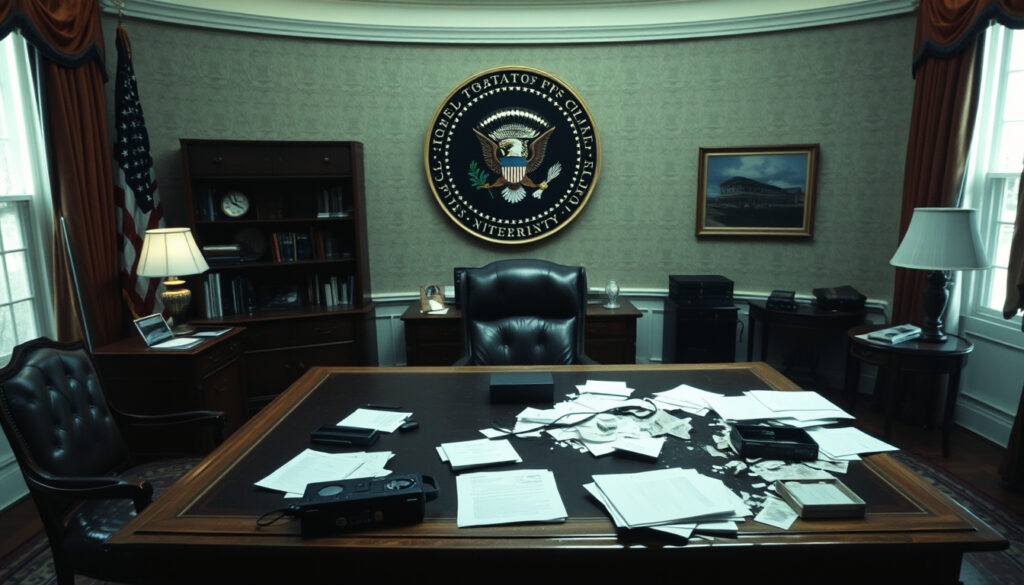
The Watergate scandal began with a burglary attempt at the Democratic National Committee headquarters in the Watergate complex in 1972, carried out by men connected to Nixon’s administration, according to Britannica and National Geographic Kids. Investigations and televised hearings revealed a broader cover-up. The Supreme Court ordered Nixon to turn over White House tape recordings that implicated him in the effort to conceal wrongdoing.
The scandal badly damaged his standing with the public and Congress, notes the Nixon Presidential Library. Facing almost certain impeachment and removal from office, Nixon announced in a televised address that he would resign. He formally left office on August 9, 1974.
It is confirmed that Nixon participated in the cover-up, as evidenced by the White House tapes. However, debate continues over whether he personally ordered the break-in itself; no direct evidence exists to prove that he did.
Why Did Nixon Resign?
Nixon resigned because the House Judiciary Committee had approved articles of impeachment for obstruction of justice, abuse of power, and contempt of Congress. With bipartisan support for conviction in the Senate, resignation became the only alternative.
What Were the Consequences of Watergate?
The scandal led to sweeping campaign finance reforms, new ethics laws, and a lasting erosion of public trust in government. It also transformed journalism, with investigative reporting at the Washington Post playing a central role in uncovering the story.
What Was Richard Nixon’s Cause of Death? His Final Years and Legacy
After leaving the White House, Nixon moved to New York City and lived for about 20 more years. He died on April 22, 1994, in New York City. According to the content plan, his cause of death was a severe stroke. Official medical records and statements are clear on this point.
Nixon’s legacy is sharply divided. Supporters point to his foreign-policy achievements, including the opening to China and the end of U.S. direct involvement in Vietnam, while critics focus on the abuses of presidential power exposed by Watergate. National Geographic Kids notes that many historians consider his abuses of power more significant than his accomplishments and describe his presidency as one of the worst in U.S. history.
President Gerald Ford pardoned Nixon on September 8, 1974. The full extent of Nixon’s legal exposure without the pardon remains speculative, as no trial ever took place.
How Old Was Richard Nixon When He Died?
Richard Nixon was 81 years old at the time of his death.
Where Did Richard Nixon Die?
He died in New York City, where he had lived in retirement.
Who Was Richard Nixon’s Vice President? His Path to the Presidency
Nixon’s political career began after World War II. He won election to the U.S. House of Representatives in 1946 and the U.S. Senate in 1950. He gained national attention through anti-communist investigations, especially the Alger Hiss case, which helped establish his reputation in Republican politics.
In 1952, Dwight D. Eisenhower selected Nixon as his running mate. Nixon served as vice president from 1953 to 1961 under Eisenhower. He traveled widely abroad and promoted U.S. policy during the Cold War, becoming one of the Republican Party’s most prominent national figures.
What Did Richard Nixon Do in WWII? Early Life and Military Service
Nixon was born on January 9, 1913, in Yorba Linda, California, and raised in nearby Whittier on a family lemon and citrus farm. His family struggled financially, and he worked to help pay for his education. He attended Whittier College and later Duke University School of Law, then returned to California to practice law.
During World War II, Nixon joined the U.S. Navy in 1942 and served as a noncombat naval aviation ground officer in the Pacific theater. He served through 1946, then returned to civilian life and entered electoral politics.
After the war, Nixon’s rapid rise from House freshman (1947) to vice president (1953) took just six years—a testament to his political skill and the anti-communist fervor of the era.
What Is Richard Nixon’s Life Timeline? Key Events From Birth to Death
- – Born in Yorba Linda, California.
- – Graduated from Duke University School of Law.
- – Served in the U.S. Navy during WWII.
- – Elected to U.S. House of Representatives.
- – Elected to U.S. Senate.
- – Served as Vice President under Dwight D. Eisenhower.
- – Lost presidential election to John F. Kennedy.
- – Elected 37th President of the United States.
- – Re-elected in a landslide; Watergate break-in occurs.
- – Resigned the presidency on August 9.
- – Died of a stroke in New York City.
What Remains Certain and Uncertain About Richard Nixon?
| Topic | Established Information | Information That Remains Unclear |
|---|---|---|
| Cause of Death | Confirmed: Richard Nixon died from a severe stroke on April 22, 1994. | None; medical records and official statements are clear. |
| Watergate Involvement | Confirmed: Nixon participated in the cover-up, as evidenced by the White House tapes. | Debate continues over whether he ordered the break-in itself; no direct evidence exists. |
| Presidential Pardon | Confirmed: President Gerald Ford pardoned Nixon on September 8, 1974. | The full extent of Nixon’s legal exposure without the pardon remains speculative. |
How Did Nixon’s Presidency Change America? Historical Context
Richard Nixon’s presidency is a study in contrasts. He achieved historic foreign policy breakthroughs, including opening relations with China and détente with the Soviet Union, while also creating the Environmental Protection Agency. However, his legacy is permanently overshadowed by the Watergate scandal, which led to his resignation—a first in American history. The scandal eroded public trust and led to sweeping campaign finance and ethics reforms. Nixon’s post-presidency saw a slow rehabilitation as a foreign policy commentator, but his reputation remains deeply polarized.
Sources and Key Quotations
The Watergate scandal badly damaged his standing with the public and Congress.
— Richard Nixon Presidential Library and Museum
National Geographic Kids notes that many historians consider his abuses of power more significant than his accomplishments, and describe his presidency as one of the worst in U.S. history.
— National Geographic Kids
Key sources used in this article include the Richard Nixon Presidential Library, the Miller Center at the University of Virginia, Britannica, the National Archives Watergate Records, and the White House Historical Association.
Summary: The Divided Legacy of Richard Nixon
Richard Nixon’s place in American history remains contested. His foreign policy achievements, especially the opening to China, stand alongside the domestic reforms of his first term. Yet Watergate—the abuse of power, the cover-up, and the resignation—has become the defining chapter of his political life. For many, it overshadows everything else. As historians continue to assess his record, the debate over Nixon’s legacy shows no sign of settling.
For further reading on other controversial historical figures, see Osama Bin Laden – Biography, Death and Enduring Legacy and Kray Twins – Complete Biography of Ronnie and Reggie Kray.
Frequently Asked Questions About Richard Nixon
How old was Richard Nixon when he died?
Richard Nixon was 81 years old when he died on April 22, 1994.
Where was Richard Nixon born?
He was born in Yorba Linda, California, on January 9, 1913.
What did Richard Nixon do in WWII?
Nixon served in the U.S. Navy as a logistics officer in the South Pacific, reaching the rank of lieutenant commander.
Who was Richard Nixon’s vice president?
His first vice president was Spiro Agnew (1969–1973), followed by Gerald Ford (1973–1974).
What is Richard Nixon’s legacy?
Nixon’s legacy is mixed: he is credited with foreign policy achievements and environmental reforms, but is most remembered for the Watergate scandal and his resignation.
When did Richard Nixon resign?
He resigned on August 9, 1974, effective immediately.
What was the Watergate break-in?
A burglary at the Democratic National Committee headquarters in the Watergate complex in 1972, carried out by men linked to Nixon’s administration.
Was Nixon vice president under Eisenhower?
Yes, he served as vice president from 1953 to 1961.
What were Nixon’s major domestic policies?
He created the Environmental Protection Agency and pursued affirmative action in federal employment.
How did Nixon change the presidency?
His abuse of power and subsequent resignation led to lasting reforms in campaign finance, ethics, and the oversight of executive authority.
More related posts
 MSC Cruises from Southampton – Ships, Prices and Itineraries for 2026-2027
 Claire Foy – Biography, Career, and Personal Life in 2025
 Andrew Ridgeley Wham – Net Worth, Wife, and Current Life
 Sue Perkins – Her Relationship, Health, and 2026 Tour
 Pixie Geldof – Biography, Husband, and Family 2025 Update
 Mmr Injection – Complete Guide for 2025
 Mat Armstrong – Age, Net Worth, Cars, and Family