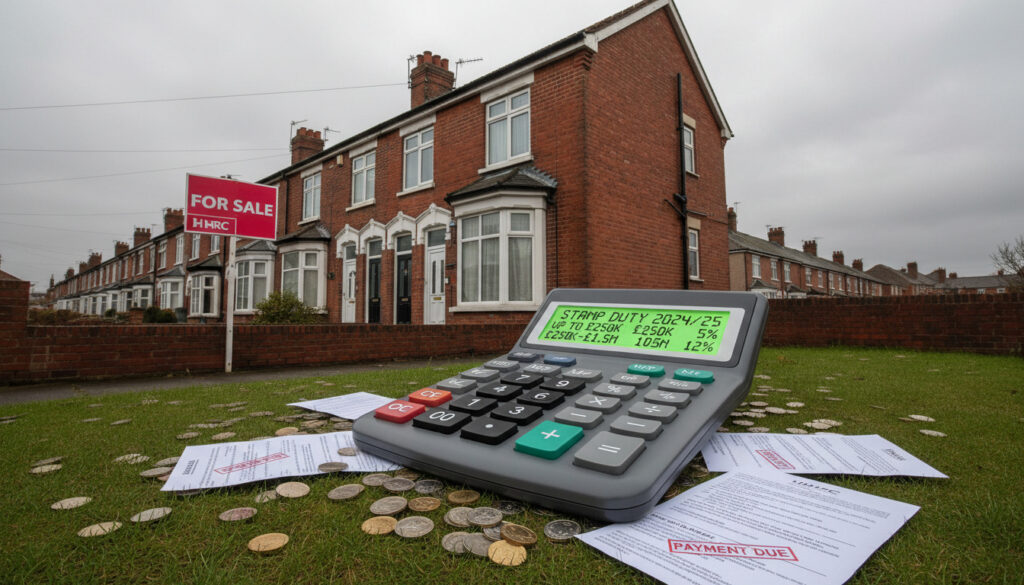
Stamp Duty Calculator UK – 2024/25 Rates and Thresholds
Stamp Duty Land Tax (SDLT) represents one of the largest upfront costs when purchasing residential property in England and Northern Ireland. The amount payable depends on the purchase price, buyer status, and whether the property serves as a primary residence or investment. Current rates apply from 31 October 2024 through 31 March 2025, following significant changes announced in the Chancellor’s October Budget.
Buyers must calculate their liability accurately to avoid unexpected costs during completion. The nil-rate threshold stands at £250,000 for standard residential purchases, while first-time buyers benefit from an extended threshold of £425,000. Second home acquisitions now attract a 5% surcharge on top of standard rates, increased from the previous 3% level.
Property transactions in Scotland and Wales fall under separate tax regimes—Land and Buildings Transaction Tax (LBTT) and Land Transaction Tax (LTT) respectively—each with distinct thresholds and percentage bands.
What are the current UK stamp duty rates and thresholds?
£250,000 nil-rate band for standard residential purchases until March 2025
£425,000 tax-free allowance for eligible first-time buyers
5% surcharge applies to additional residential properties from October 2024
Purchase price, buyer status, property type, and location determine liability
- Nil-rate threshold holds at £250,000 for general residential buyers through 31 March 2025
- First-time buyers save up to £6,250 compared to standard rates on purchases up to £425,000
- Second home surcharge increased by two percentage points to 5% in the October 2024 Budget
- Corporate purchases over £500,000 now face a 17% flat rate, up from 15%
- Leasehold transactions incur additional tax on the net present value of rent exceeding £150,000
- Regional variations apply in Scotland and Wales with completely separate tax bands
- Transitional protection exists for contracts exchanged before 31 October 2024 but completed afterward
| Purchase Price Band | Standard Rate | First-Time Buyer Rate | Second Home Rate |
|---|---|---|---|
| Up to £250,000 | 0% | 0% | 5% |
| £250,001 to £425,000 | 5% | 0% | 8% |
| £425,001 to £625,000 | 5% | 5% | 8% |
| £625,001 to £925,000 | 5% | 5% | 8% |
| £925,001 to £1.5 million | 10% | 10% | 13% |
| Above £1.5 million | 12% | 12% | 15% |
The UK government publishes official rate tables covering the period from 31 October 2024 to 31 March 2025 here.
How much stamp duty will I pay on my property purchase?
Calculating the exact liability requires applying the relevant percentage to each portion of the purchase price that falls within specific bands. For a £300,000 primary residence, the first £250,000 incurs no tax, while the remaining £50,000 attracts 5% duty, resulting in a £2,500 payment.
To determine your precise liability, gather four key details before using any calculator: the exact purchase price, confirmation of whether you own other residential property anywhere in the world, the intended use of the new property (primary home or rental), and the completion date to check for transitional rate applicability.
The official SDLT calculator provided by HM Revenue & Customs accepts these inputs and applies the correct tiered calculations automatically. Third-party calculators offered by mortgage brokers and property portals typically incorporate the same algorithms but may present results alongside financing options.
For leasehold purchases, the calculation splits into two components. The premium paid for the property itself follows standard residential rates, while the net present value of annual rent exceeding £150,000 incurs an additional 1% charge.
Do first-time buyers pay stamp duty in the UK?
First-time buyers purchasing properties up to £425,000 pay no SDLT whatsoever. For purchases between £425,001 and £625,000, a reduced 5% rate applies only to the portion exceeding £425,000. Properties costing more than £625,000 lose first-time buyer relief entirely, reverting to standard rates.
To qualify, every buyer named on the deed must have never previously owned a residential property anywhere in the world, including inherited property or overseas homes. The purchase must serve as the buyer’s only or main residence, excluding buy-to-let investments. The relief applies strictly to individuals; corporate purchasers cannot claim first-time buyer status regardless of director history.
Who qualifies for first-time buyer relief?
Eligibility requires that neither the buyer nor their spouse or civil partner has owned residential property previously. This restriction applies globally, catching overseas properties and fractional ownership schemes. Property investment specialists note that many buyers mistakenly assume previous ownership of commercial property or land affects eligibility, but the restriction applies solely to residential dwellings.
The maximum qualifying property price for any first-time buyer relief stands at £625,000. Above this threshold, standard tiered rates apply to the entire purchase price without the £425,000 nil-rate allowance.
What is stamp duty on second homes and buy-to-let properties?
Purchases of additional residential properties—defined as those not replacing a main residence within three years—attract a 5% surcharge on top of standard SDLT rates. This increased rate took effect on 31 October 2024, representing a two percentage point rise from the previous 3% surcharge that applied since April 2016. For those considering purchasing a second home or buy-to-let property in the city, our Edinburgh park and ride guide offers comprehensive details.
Contracts exchanged on or before 30 October 2024 but completing after 31 October 2024 retain the old 3% surcharge rate rather than the new 5% rate. This protection applies only where the contract terms remain unchanged; any variation triggers the higher rate.
Second home rate structure
The effective rates for second homes currently stand at 5% on the first £250,000, 8% on the portion between £250,001 and £925,000, 13% up to £1.5 million, and 15% beyond that point. International property consultants confirm these rates apply equally to UK residents purchasing holiday homes and foreign investors acquiring buy-to-let portfolios.
Replacement of a main residence generally avoids the surcharge, provided the previous main residence is sold within three years of completing the new purchase. Refunds are available for the surcharge paid if the former home sells after completion but within the three-year window.
How have stamp duty rates changed over time?
- : HM Treasury introduces 15% flat rate for corporate bodies purchasing residential dwellings exceeding £500,000
- : 3% surcharge implemented for purchases of additional residential properties
- : Chancellor raises second home surcharge from 3% to 5% in Autumn Budget
- : Corporate purchase rate increases from 15% to 17% for dwellings over £500,000
- : Current temporary rate schedule expires; future thresholds subject to policy review
Mortgage advisory services highlight that the October 2024 changes represent the most significant SDLT revision since the 2016 surcharge introduction, adding substantial costs for investors and corporate buyers while maintaining relief for first-time purchasers.
What is certain about current stamp duty rules?
Established Information
- Nil-rate threshold fixed at £250,000 until 31 March 2025
- First-time buyer relief capped at £425,000 until 31 March 2025
- Second home surcharge definitively set at 5%
- Corporate rate of 17% confirmed for >£500,000 purchases
- Transitional rules protecting pre-October 2024 contracts
Remaining Unclear
- Whether nil-rate thresholds will revert to £125,000 after March 2025
- Status of first-time buyer relief beyond March 2025
- Potential further adjustments to surcharge percentages
- Confirmation of permanent vs temporary nature of current rates
- Detailed guidance on mixed-use property classifications
Why does stamp duty vary across the UK?
Devolution of property taxation powers means Scotland and Wales operate independent systems from England and Northern Ireland. Scotland applies Land and Buildings Transaction Tax (LBTT) with a £175,000 nil-rate threshold for primary residences, while Wales uses Land Transaction Tax (LTT) with bands ranging from 0% to 12% depending on property value.
Scottish second home purchases attract a 6% Additional Dwelling Supplement from the first pound, differing from the tiered English approach. Financial comparison platforms note that these regional variations can create significant cost differences for identical property prices—for instance, a £400,000 purchase incurs different liabilities in Edinburgh, Cardiff, and London despite the same market value.
Buyers considering Gov.uk Renew Driving Licence at 70 – Complete DVLA Guide should note that administrative processes for property and vehicle documentation both require strict compliance with government verification standards, though they fall under different departmental jurisdictions.
Where do stamp duty rates come from?
HM Revenue & Customs administers SDLT under powers granted by the Finance Act 2003 and subsequent amendments. The Treasury sets rates through annual Budget statements and occasional fiscal events, with the most recent statutory instrument establishing the October 2024 to March 2025 schedule.
Stamp Duty Land Tax is charged on land transactions in England and Northern Ireland where the chargeable consideration exceeds the relevant threshold. The rates and thresholds are specified by the Treasury and collected by HM Revenue & Customs.
— HM Revenue & Customs, SDLT Technical Guidance
Primary legislation defines the tax base, while secondary legislation and HMRC guidance interpret specific scenarios such as linked transactions, transfers between connected persons, and the treatment of alternative property finance arrangements.
What should property buyers know about stamp duty?
Accurate calculation requires understanding your buyer status, the property’s intended use, and the applicable rate period. First-time buyers enjoy substantial savings up to £425,000, while investors face increased costs following the October 2024 surcharge rise. Buyers should verify their liability using the official government calculator and consider completing purchases before 31 March 2025 to lock in current thresholds, as future rates remain unconfirmed. For immediate calculations, use the Stamp Duty Calculator UK – Rates and Thresholds 2024/25.
Frequently Asked Questions
How do I use a stamp duty calculator correctly?
Enter the exact purchase price including fixtures and fittings if chargeable. Select your buyer status accurately—first-time, replacement main residence, or additional property. Specify whether you own other residential property globally. Input the completion date to determine applicable rates. Review the tiered breakdown showing tax per band rather than a single percentage.
Is stamp duty increasing in 2025?
Current temporary rates expire on 31 March 2025. The government has not confirmed whether thresholds will revert to previous levels, specifically the £125,000 nil-rate band that applied before temporary COVID-19 increases. Buyers completing after March 2025 should budget for potential increases pending Budget announcements.
How is stamp duty calculated on leasehold properties?
The premium paid for the leasehold interest attracts standard SDLT rates. Separately, the net present value of rent payable over the lease term attracts 0% up to £150,000 and 1% above that threshold. Short leases under seven years generally incur no rent-related charge.
Do companies pay higher stamp duty than individuals?
Corporate bodies purchasing residential dwellings exceeding £500,000 pay a flat 17% rate, significantly higher than tiered individual rates. This applies to companies, collective investment schemes, and certain partnerships. The rate increased from 15% on 31 October 2024.
What are the differences between SDLT, LBTT, and LTT?
SDLT applies in England and Northern Ireland with a £250,000 standard threshold. Scotland’s LBTT starts at £175,000 for main residences with different percentage bands. Wales’ LTT uses distinct thresholds with maximum rates of 12% on portions over £1.5 million. Each regime maintains separate rules for reliefs and second homes.
More related posts
 ASAP Rocky – Biography, Net Worth, and 2025 Tour
 Cast of the Great Escaper – Full List, Roles and True Story
 Kim Taehyung – Age, Height, Family and Career Facts
 Rashmika Mandanna – Age, Height, Movies, Husband & Instagram
 The Fantastic Four First Steps – Release Date, Cast, Where to Watch
 Ruth Jones – Welsh Actress, Writer and BAFTA Winner
 Toyota Hire Near Me – Local Dealership and Factory Jobs
 David Moyes – Teams, Net Worth, Family & 2025 Career Update