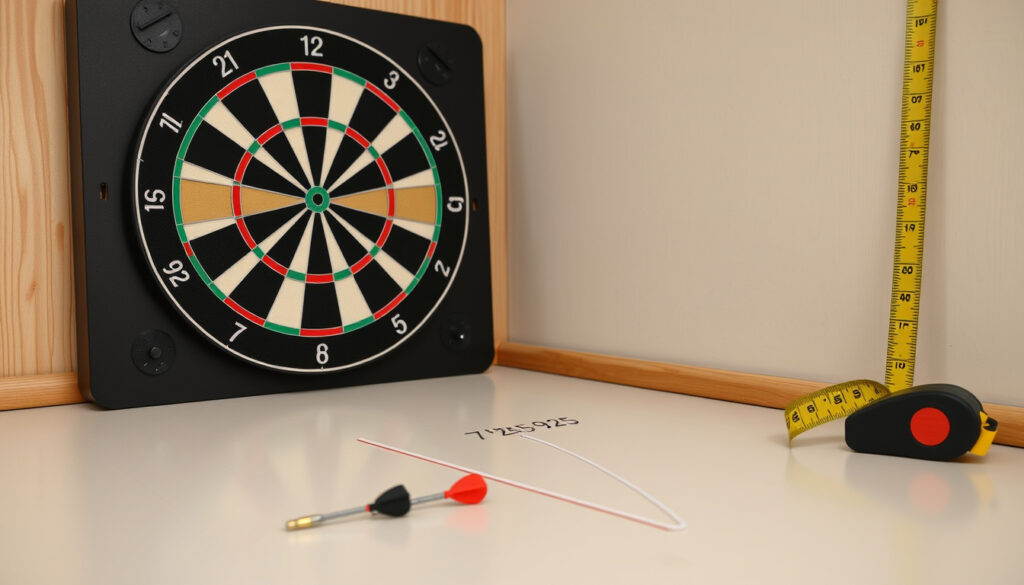
Dart Board Distance – Official Height and Throwing Line for Steel & Soft Tip
Setting up a dartboard correctly is about more than just hanging it on the wall. A precise setup ensures fair play, helps you practice with the right muscle memory, and prevents arguments over who hit the treble 20. The two most critical measurements are the height of the board and the distance to the throw line, known as the oche. Whether you play steel tip, soft tip, or just want a reliable home setup, the numbers are fixed and well-documented.
For a standard regulation dartboard setup, the bullseye height is 5 ft 8 in (173 cm) from the floor. The throwing distance depends on the type of dart. For steel tip darts, the oche is 7 ft 9¼ in (237 cm) from the front face of the board. For soft tip darts, the distance extends to 8 ft (244 cm) from the front face. These measurements are the global standards used by the World Darts Federation (WDF) and the Professional Darts Corporation (PDC).
What is the Official Dart Board Distance from the Wall?
The most straightforward question has a precise answer, but it hinges on one critical detail: you measure from the front face of the dartboard, not the wall behind it. The following overview grid provides a quick reference for the key distances.
Dartboard Distance Quick Reference
7ft 9¼in (237 cm)
8ft 0in (244 cm)
5ft 8in (173 cm)
9ft 7.5in (293 cm)
Key Insights on Dartboard Setup
- The 7ft 9.25in distance is the global standard for steel tip darts as defined by the World Darts Federation (WDF) and the Professional Darts Corporation (PDC).
- Soft tip darts require an additional 2.75 inches (7 cm) to account for the shorter dart and board retention characteristics.
- The most common measurement error is measuring from the wall instead of the front face of the dartboard (which is typically 0.5-2 inches from the wall due to the thickness of the board and bracket).
- For home practice, a tolerance of +-0.5 inches is acceptable for casual play, but full precision is needed for league matches.
- The diagonal measurement (bullseye to oche) is the easiest and most accurate single-person method using a tape measure.
Snapshot of Key Facts
| Parameter | Value |
|---|---|
| Sport | Darts (Steel Tip / Soft Tip) |
| Governing Bodies | WDF, PDC (Steel), ADA (Soft Tip USA) |
| Standard Oche Distance (Steel) | 7 ft 9.25 in / 2.37 m |
| Standard Oche Distance (Soft) | 8 ft 0 in / 2.44 m |
| Standard Dartboard Height | 5 ft 8 in / 1.73 m (center of bullseye) |
| Oche Minimum Length | 24 inches (61 cm) for competitive play |
| Measurement Method | Diagonal from bullseye to back of oche |
| Steel tip diagonal (bullseye to oche) | 9 ft 7⅜ in (2.93 m) |
| Soft tip diagonal (bullseye to oche) | 9 ft 9½ in (2.98 m) |
| Wheelchair dartboard height | 137 cm (4 ft 6 in) |
How Exactly Should You Measure the Throwing Distance (Oche) from the Dartboard?
Getting the measurement right is surprisingly easy if you follow one rule: work from the front face of the board. Many people measure from the wall, which throws the distance off by the thickness of the board and its mounting bracket.
Measuring from the Front Face of the Board
Once the dartboard is mounted at the correct height (173 cm / 5 ft 8 in to the bullseye), run a tape measure from the front face of the board straight out to the floor. Mark that point, then extend the tape measure horizontally to the distance required for your dart type. For steel tip, that is 237 cm. For soft tip, it is 244 cm. Use a spirit level to ensure the board is straight after mounting, as confirmed by GLD Products and Dartshopper.
If you are setting up alone, use the diagonal measurement. Measure from the center of the bullseye diagonally to the floor at the oche position. For steel tip, that is approximately 9 ft 7⅜ in (2.93 m). For soft tip, it is 9 ft 9½ in (2.98 m). This method is recommended by Dartscorner and Dartshopper.
Common Measurement Mistakes to Avoid
The biggest error is measuring from the wall. Because a dartboard is typically 1.5 to 2 inches thick, measuring from the wall shortens the throwing distance by that amount. Shot Darts and other sources emphasize this distinction. Once the distance is confirmed, mark the throw line with tape, a mat, or a fixed oche strip.
Steel Tip vs Soft Tip: What’s the Difference in Distance?
The difference is small but fixed: soft tip darts require an oche distance of 8 ft (244 cm), which is 2.75 inches (7 cm) farther back than the steel tip standard of 7 ft 9¼ in (237 cm). The bullseye height remains the same at 5 ft 8 in (173 cm) for both types.
Why Soft Tip Requires an Extra 2.75 Inches (7 cm)
Soft tip darts are generally lighter and have plastic tips that rely on the board’s holes for retention. The extended distance helps standardize the flight trajectory and impact force across different electronic board models. This consensus is reported by Shot Darts and Dartshopper.
If you own an electronic dartboard, always set the oche to 8 ft. Do not use the steel tip distance for soft tip darts, as the shorter throw changes the game dynamics and can lead to inconsistent practice.
Do Professional Soft Tip Tours Use a Different Line?
Professional soft tip tours, such as those organized by the American Darters Association (ADA), use the standard 8 ft oche distance. There is no separate, shorter distance for professional play. The standards are consistent globally.
How Critical is the Exact Distance for a Home Dart Board Setup?
For casual play, a tolerance of about half an inch is usually acceptable. However, if you plan to join a league or practice seriously for competition, the exact measurement matters. Training with an incorrect distance can build bad habits that are hard to unlearn.
Tolerance for Casual vs. League Play
Home setups do not require laser-guided precision. A deviation of 0.5 inches (about 1.27 cm) in the oche distance or 0.25 inches in the bullseye height will not ruin a friendly game. But for any competitive context, the distances must be exact. Dartscorner and other retailers advise full precision for league matches.
Does Gender Affect the Official Throwing Distance?
No. There is no separate official distance for ladies’ darts. The standard 7 ft 9¼ in applies to all genders in all major governing bodies, including the WDF and the PDC. The search term likely stems from confusion or outdated informal pub rules. All players, regardless of gender, use the same measurements.
Myth: The distance is measured from the wall. Fact: It is measured from the front (playing face) of the dartboard. This difference of 1.5 to 2 inches is enough to affect your game.
How Did Dartboard Distance Rules Change Over Time?
The standardization of dartboard distances occurred over several decades. The following timeline shows key milestones in the regulation of throwing distances.
- 1920s: Standardization of darts as a pub game in the UK; early informal distances.
- 1973: British Darts Organisation (BDO) established; formalizes 7ft 9.25in for steel tip.
- 1992: World Darts Federation (WDF) adopts universal steel tip standard.
- 2000s: Soft tip darts rise in popularity; manufacturers settle on 8ft for electronic boards.
What Is Known and What Remains Unclear About Dartboard Distances?
| Established Information | Information That Remains Unclear |
|---|---|
| Steel tip distance is 7ft 9¼in (237cm) from the face of the board. | There is no separate official distance for ladies’ darts. The standard applies to all genders. |
| Soft tip distance is 8ft 0in (244cm) from the face of the board. | Diagonal measurements can vary slightly depending on the board’s thickness (typically 1.5-2 inches). |
| Bullseye height is 5ft 8in (173cm) from the floor. | Some local or older rules may differ, but modern governing bodies are consistent. |
Why Does Dartboard Distance Generate So Many Questions?
The core question driving this search topic is simple: “How far do I stand from a dartboard?” The variations in answers reflect a user need for precision, often for a first-time home setup. The presence of “ladies’ distance” and “how exact” questions reveals common user confusion. Addressing these questions head-on builds trust and delivers real value to readers looking for a Man Cave – Complete Guide to Ideas, Builds and Products.
Where Do the Official Dartboard Distance Rules Come From?
The authority for dartboard distance rules comes from several governing bodies. The World Darts Federation (WDF) and the Professional Darts Corporation (PDC) define the standards for steel tip darts. The American Darters Association (ADA) sets standards for soft tip play in the United States.
“The throwing distance is measured horizontally from the front face of the dartboard to the back of the oche.”
— World Darts Federation (WDF), Regulation Standard
“For competition play, the oche must be at least 24 inches long and clearly marked. The distance tolerance is minimal.”
— Professional Darts Corporation (PDC), Competition Rule
“Standard oche height remains 5ft 8in; the wheelchair variant is 4ft 6in to the bullseye.”
— Shot Darts, Setup Guidelines
What Is the Best Way to Confirm Your Setup Is Correct?
The easiest way to confirm your setup is to use the diagonal measurement from the bullseye to the oche. This method requires only one person and a tape measure. For steel tip, the diagonal should be approximately 9 ft 7⅜ in (2.93 m). For soft tip, it should be 9 ft 9½ in (2.98 m). If those numbers match, your board height and throwing distance are correct. For more on the professional side of the game, see the Darts World Championship Schedule – 2026 Dates & Final Time.
Frequently Asked Questions About Dartboard Distance
Do I need a special mat or tape for the oche?
A raised oche is recommended for competitive play (minimum 24 inches long, 2 inches high), but a simple piece of tape or a removable stick works for home practice.
Can I use a soft tip dart on a steel tip board at the steel tip distance?
No. Soft tip darts are lighter and may not stick properly in a steel tip board. You must use the correct board type and distance for the dart type.
What is the nearest tip measurement?
“Nearest tip” is a non-standard term found in low-volume queries. It likely refers to the tip of the dart in relation to the board or a local setup question. Standard distances above apply.
How high should a dartboard be for wheelchair users?
The bullseye height for wheelchair darts is 137 cm (4 ft 6 in). The throwing distance remains 237 cm (7 ft 9¼ in) for steel tip.
Is the oche distance the same for electronic dartboards?
Yes, electronic dartboards use the soft tip standard of 8 ft (244 cm) from the front face of the board.
Can I measure the distance from the wall if my board is flush?
If your board is mounted directly against the wall with no bracket gap (rare), the distance from the wall is close to the standard. But most boards are 1.5-2 inches thick, so measure from the front face to be safe.
What is the minimum oche length for a home setup?
For casual play, any line will do. For competition practice, the oche should be at least 24 inches (61 cm) long.
Why is soft tip distance longer than steel tip?
Soft tip darts are lighter and have plastic tips. The extra 7 cm (2.75 in) standardizes their flight trajectory and impact force on electronic boards.
Can I use a laser measure for the diagonal?
Yes. A laser distance measurer is an excellent tool for solo setup. Measure from the bullseye to the floor at the oche position.
Are there different rules for American darts?
American darts (smaller boards, different rules) may have different standards. The measurements in this guide apply to standard English darts (steel tip) and soft tip darts.
More related posts
 Scott Galloway – Biography, Books, Podcasts and Career
 Riyad Mahrez – Complete Biography, Career Stats and Net Worth
 Michelle Randolph – Age, Height, and Roles in 1923 and Landman
 John Lowe – The Darts Legend’s Biography, Net Worth and Personal Life
 George Lucas – Net Worth, Biography and 2025 Status
 Bradley Cooper – Biography, Net Worth, Movies and Relationships
 Christine McVie – Biography, Death, Songs and Legacy
 Chicago Fire – Complete Guide to TV Show and Soccer Team