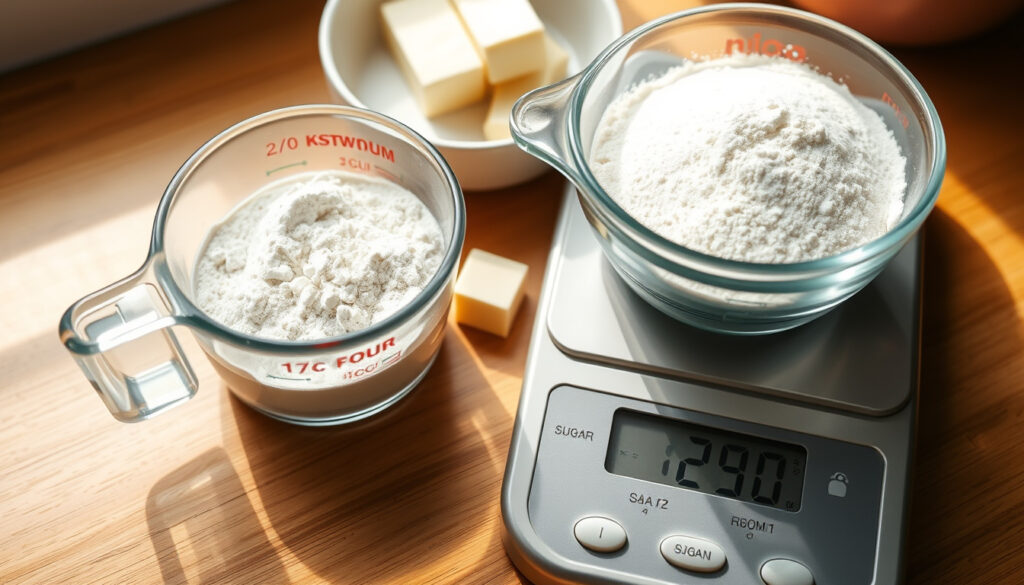
1/3 Cup in Grams – Weights for Flour, Butter, Sugar
Converting cup measurements to grams is a common challenge in baking, where precision matters more than in everyday cooking. A US cup measures 240 milliliters, but the weight in grams varies significantly depending on the ingredient. This guide focuses specifically on 1/3 cup conversions across flour, butter, and sugar, with supporting data for other common fractions.
Understanding these conversions helps home bakers achieve consistent results. Whether following an American recipe or adapting European measurements, knowing exactly how much a 1/3 cup weighs ensures your cookies, cakes, and breads turn out as intended.
How Many Grams is 1/3 Cup?
The weight of 1/3 cup varies by ingredient due to density differences. Flour is lightest, sugar falls in the middle, and butter is heaviest per volume.
| Ingredient | 1/3 Cup (g) | 1/4 Cup (g) | 1/2 Cup (g) |
|---|---|---|---|
| Flour (unsifted) | 40g | 30g | 60g |
| Flour (sifted) | 35g | 27g | 55g |
| Sugar (granulated) | 67g | 50g | 100g |
| Butter | 76g | 57g | 113g |
For 1/3 cup of butter, most sources agree on approximately 76 grams. Granulated sugar converts to about 67 grams, while unsifted all-purpose flour comes in at roughly 40 grams per 1/3 cup.
- A US cup equals 240 milliliters, though some sources reference 250ml for metric cup measurements
- Ingredient density causes the biggest variation—flour is porous while butter is dense
- Sifting flour aerates it, reducing weight by about 5-10 grams per 1/3 cup
- Packing brown sugar firmly increases its weight compared to loose pouring
- Humidity affects flour weight, making kitchen scales more reliable than volume measures
- One stick of butter equals 1/2 cup (113g), making 1/3 cup slightly more than half a stick
For consistent results, fluff flour with a fork before scooping. Lightly spoon it into the cup and level with a knife. Never scoop directly from the bag, as this compacts the flour and yields up to 20% more than intended.
| Measurement | Flour Unsifted (g) | Granulated Sugar (g) | Butter (g) |
|---|---|---|---|
| 1/3 cup | 40g | 67g | 76g |
| 1/4 cup | 30g | 50g | 57g |
| 1/2 cup | 60g | 100g | 113g |
| 1 cup | 120g | 200g | 227g |
1/4 Cup in Grams
Quarter cup measurements provide useful reference points for smaller recipe adjustments. Converting 1/4 cup to grams gives 30 grams for unsifted flour, 50 grams for granulated sugar, and 57 grams for butter.
When a recipe calls for 1/4 cup of butter, you’re looking at roughly 57 grams—about half of a standard stick. For 1/4 cup of flour, 30 grams is the typical unsifted measurement, though sifted flour drops to approximately 27 grams. Granulated sugar at this volume weighs around 50 grams.
Brown sugar behaves differently due to its moisture content and crystal structure. When packed firmly, 1/4 cup of brown sugar measures approximately 45 to 55 grams depending on the source and how tightly it’s pressed. This variation matters when precision is critical, such as in chewy cookie recipes where brown sugar plays a key structural role.
1/2 Cup and 1 Cup in Grams
Half cup measurements are common in baking, particularly for butter. A 1/2 cup of butter equals one full stick, weighing approximately 113 grams. This is the most reliable conversion across sources, as butter maintains consistent density.
For 1/2 cup of unsifted flour, expect about 60 grams. Sifted flour reduces to roughly 55 grams. Granulated sugar at this volume reaches 100 grams, making it a convenient conversion since the numbers align closely with the fraction notation.
Why Precision Matters for Butter
Butter conversions are particularly stable because its fat content and water ratio remain consistent across brands. A 1/2 cup block of butter from any manufacturer will weigh within a narrow range of 113 to 120 grams. This predictability makes butter a reliable anchor ingredient when testing conversion accuracy.
Minor discrepancies of 5-20% exist between sources due to different testing methods. For best results, use a kitchen scale rather than relying on volume measurements alone.
Other Common Cup Measurements in Grams
Beyond the primary fractions, recipes frequently call for 3/4 cup and full cup measurements. A full cup of unsifted flour weighs approximately 120 grams, while sifted flour comes in at 110 grams. Granulated sugar reaches 200 grams per cup, making it roughly twice the weight of flour at equivalent volume.
Brown sugar requires specific handling. When packed, 1 cup of brown sugar can weigh between 180 and 220 grams depending on compaction method. Professional bakers often press brown sugar firmly into the cup measure and then level it to achieve consistent results.
Extended Measurements
Larger measurements like 1 1/2 cups and 1 1/4 cups follow the same density principles. Doubling the 1/2 cup values provides reliable estimates: 1 1/2 cups of butter equals approximately 340 grams, while 1 1/4 cups of flour (unsifted) reaches about 150 grams.
For icing or powdered sugar, the conversion shifts again. One cup typically ranges from 100 to 135 grams depending on how the powder settles and the humidity conditions. King Arthur’s ingredient weight chart provides comprehensive reference values for specialty ingredients beyond common baking staples.
Why Cup-to-Gram Conversions Vary by Ingredient
The fundamental reason for conversion variation lies in ingredient density. A cup measures volume, while a gram measures mass. Water achieves 240 grams per cup because its density is 1 gram per milliliter. Flour, however, contains air pockets between particles, reducing its overall density to roughly half that of water.
Fatty ingredients like butter approach water’s density more closely, which explains why a cup of butter yields approximately 227 to 240 grams—much closer to the theoretical 240g water baseline. Sugar crystals pack more densely than flour particles but still fall short of water’s weight per volume.
Different cup standards also contribute to confusion. The US customary cup measures exactly 240 milliliters, while an imperial cup used in some Commonwealth countries holds 284 milliliters. Metric countries sometimes reference a 250-milliliter cup. This distinction matters when converting international recipes, particularly those sourced from British publishers.
Dips and spoons methods yield lighter weights than scooping directly from containers. The way flour is handled—scooped versus spooned into the cup—can alter the conversion by 20 grams or more per cup.
What We Know for Certain and What Remains Unclear
| Established Information | Information That Varies |
|---|---|
| US cup = 240ml | Exact flour weight depends on sifting method |
| Butter 1/2 cup reliably equals 113g (one stick) | Brown sugar weight varies with packing pressure |
| Granulated sugar consistently converts around 200g per cup | Humidity affects flour weight day-to-day |
| Butter 1/3 cup falls between 76-80g | Different brands may yield slightly different weights |
| Sifting reduces flour weight by approximately 10% | Measuring cup shape can influence volume |
Minor discrepancies of 5 to 20 percent exist across conversion sources due to different testing methodologies. Brands and testing facilities do not always use identical preparation techniques when establishing their reference values.
Sources and Standards
Conversion data in this guide draws from established baking resources including specialty flour manufacturers, recipe sites, and educational institutions. The Wikipedia entry on cup measurements provides historical context for standardized cup volumes across different regions.
Standard US cup measurements derive from the Customary System, with 1 cup officially defined as exactly 236.588 milliliters, though 240ml serves as a commonly accepted approximation.
Government food and nutrition resources from the USDA food and nutrition division support standardized kitchen measurement practices for public health and dietary tracking purposes.
Summary
Converting 1/3 cup to grams requires knowing the specific ingredient, as weights vary significantly: approximately 40 grams for unsifted flour, 67 grams for granulated sugar, and 76 grams for butter. These values align with most major baking resources, though minor variations exist between sources due to testing methods and ingredient preparation.
For the most accurate results, a kitchen scale provides reliable measurements regardless of how ingredients are packed or sifted. While cup-to-gram conversions serve as useful reference points, weighing ingredients directly eliminates the guesswork that volume measurements introduce. Understanding these conversions also helps when adapting recipes between American and metric kitchens, such as when calculating length measurements in international projects or currency conversions for foreign recipe ingredients.
Frequently Asked Questions
How much is 1 1/2 cups in grams?
1 1/2 cups of butter equals approximately 340g. For flour (unsifted), expect around 180g, and granulated sugar reaches about 300g.
How many grams is 1 1/4 cups of butter?
1 1/4 cups of butter weighs roughly 284 grams. Since one stick is 113g, this represents a little more than 2.5 sticks of butter.
What does 1 cup of flour equal in grams?
One cup of unsifted all-purpose flour equals approximately 120 grams. Sifted flour reduces to about 110 grams per cup.
Is 1/3 cup of butter the same as half a stick?
No, 1/3 cup slightly exceeds half a stick. A full stick is 1/2 cup (113g), while 1/3 cup is 76g—just over half a stick.
Why do conversion charts disagree on flour weights?
Flour conversion differences stem from sifting, scooping technique, and humidity. Scooping directly from the bag can yield 150g per cup, while spooning and leveling produces 120g. Always check whether the source specifies sifted or unsifted measurements.
Can I use a kitchen scale instead of cup measurements?
Yes, using a scale provides the most accurate results. Digital kitchen scales are affordable, widely available, and eliminate the variability introduced by different scooping and packing methods.
More related posts
 Maisie Adams – Age, Husband, Height, Tour & Taskmaster Win
 Pixie Geldof – Biography, Husband, and Family 2025 Update
 George Lucas – Net Worth, Biography and 2025 Status
 Jj Gabriel – The 15-Year-Old Prodigy at Manchester United
 Jason Voorhees – Complete Guide to the Friday the 13th Icon
 When Was Football Invented – Complete Origins and History
 Michelle Randolph – Age, Height, and Roles in 1923 and Landman
 Anna Woolhouse – Biography, Career and Relationship Update